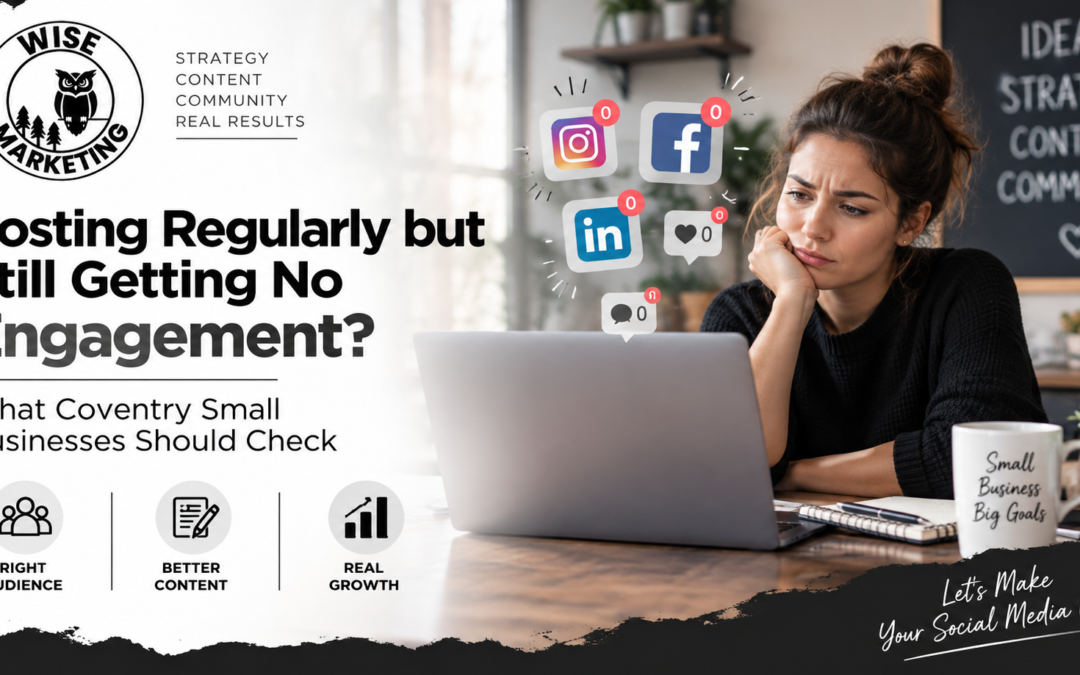
Posting consistently on social media takes time. You create graphics, share photos, write captions, and make sure something goes live every week. But after all that effort, seeing only a few likes, no comments, and very little interaction can be frustrating.
For Coventry small businesses, low engagement does not necessarily mean social media is not working for your industry. Often, the problem is the type of content being shared, who it is designed for, or what happens after it is published. Posting regularly is useful, but consistency alone does not guarantee meaningful engagement.
Start With the People You Want to Reach
Before creating another post, think about exactly who should care about it.
A local contractor may need to reach homeowners, while an accounting firm may be speaking to business owners. A restaurant, retailer, or professional service will have a different audience again.
If content is written for everyone, it often feels relevant to no one. Instead of starting with “What should we post today?” start with “What does our customer want to know?”
Wise Marketing describes audience research, content planning, publishing, and profile reviews as parts of social media management—not simply maintaining a posting schedule.
Your Content May Be Too Promotional
One common reason people stop interacting with a business account is that every post feels like an advertisement.
“Call us today.” “Buy now.” “Book an appointment.” “Choose our company.” These messages have a place, but when nearly every post asks for a sale, followers have little reason to keep paying attention.
Try balancing promotional posts with educational tips, frequently asked questions, behind-the-scenes content, customer stories, simple explanations, local information, and useful advice related to your industry. Wise Marketing’s own social-media guidance emphasizes content designed around connection and communication rather than promotions without a broader strategy.
Give People a Reason to Respond
Sometimes a post is informative but gives the reader nowhere to go next.
Imagine a roofing company posts, “We provide roof inspections in Connecticut.” The information is clear, but there is not much to respond to.
A post such as “Have you checked your roof after the last heavy storm?” creates a natural opening for conversation. A remodeling company could ask which room homeowners would renovate first. A restaurant could ask customers to choose between two dishes.
Questions should feel natural rather than being added simply to collect comments.
Use Real and Relatable Visuals
Highly polished graphics can look professional, but using designed promotional images for every post can make a social feed feel repetitive.
Mixing in real photos can make a business feel more approachable. Depending on the company, this might include employees at work, a completed project, products, a workspace, an event, or an appropriate behind-the-scenes moment.
Video can also help businesses tell their stories in a more natural way. Wise Marketing includes video alongside written and social content within its broader content services.
Don’t Post Exactly the Same Way Everywhere
Facebook, Instagram, LinkedIn, Pinterest, and other platforms are not identical communities.
A detailed professional insight that works on LinkedIn may need to become a short visual explanation on Instagram. A Facebook post may encourage community discussion, while Pinterest content may focus more heavily on useful, searchable ideas.
Wise Marketing specifically describes platform-focused approaches across Facebook, Instagram, LinkedIn, Pinterest, and other social channels.
Businesses looking for professional social media management services in Coventry should therefore think beyond how frequently content is posted and consider whether each post actually suits the platform and intended audience.
Look Beyond Likes
Low likes do not automatically mean a post failed, and a high number of likes does not automatically mean it helped the business.
Look at other signals too. Are people saving or sharing posts? Are they visiting the profile? Are website clicks increasing? Are people sending messages, calling the business, or mentioning something they saw online?
The useful metrics depend on the goal. If the objective is awareness, reach and impressions may matter. If the objective is website traffic, clicks become more important. For lead generation, inquiries and conversions may deserve greater attention.
Engagement Also Requires Engagement
Social media is designed for interaction.
Publishing a post and disappearing until the next scheduled post can limit opportunities to build relationships. When appropriate, businesses can respond to comments, answer questions, acknowledge mentions, and participate genuinely in relevant conversations.
This does not mean leaving promotional comments everywhere. The goal is to behave like a real member of the community rather than using social media as a one-way advertising board.
Review What Has Already Worked
You do not always need completely new ideas. Your existing data can tell you what your audience finds interesting.
Look back at recent posts. Which received the most saves, comments, shares, clicks, or meaningful responses? Was it a customer question? A real photo? A short video? An educational tip?
Then compare those posts with the ones that received little attention. Patterns can help you decide what to create more often and what needs to change.
Final Thoughts
If your Coventry business is posting consistently but receiving little engagement, increasing the number of posts may not be the answer.
First review your audience, content topics, promotional balance, visuals, platform strategy, calls to action, community interaction, and performance data. Social media becomes more useful when each post has a clear purpose and gives the right audience something worth noticing.
Consistency still matters—but relevant, useful, human content is what can turn a posting schedule into a stronger connection with the people your business wants to reach.